& a vintage letter from Mark Twain…


IMG_6643

Fresh Cream of Corn Chowder with a Kick… + a side of my secret recipe Raw Vegan Onion Rings!


Fresh Cream of Corn Chowder with a Kick is a celebration of summer in a bowl!

This simple and delicious recipe takes full advantage of local farmers' markets, currently overflowing with the plumpest, juiciest ears of succulent corn.  Golden jewels so honey-sweet and tender they're best fresh off the cob.  If you've ever eaten corn fresh, standing in the middle of (an organic) corn field you understand perfectly why subjecting these pale golden delicacies to steaming kettles of boiling water or smoking hot grills is a practical crime.  Besides, who seriously wants to deal with hot steam or smoking grills on a beautiful summer day?!

**Do you spot my napkin (below) on which a vintage letter from Mark Twain is printed?  More on this in my personal comments after the recipe 🙂


IMG_6661

Beautiful, fresh foods brimming with life force have taken me to physical, mental & spiritual levels I never imagined possible!


This cool, creamy bowl of goodness boasts a wonderfully thick chowder texture, the freshest, sublime corn flavor and a perfect kick of smoked paprika & tabasco.  I've paired it here with my Raw Vegan Onion Rings (the recipe for which I'm equally excited to share with you soon!).  As with all StyleNectar raw vegan dishes, Fresh Cream of Corn Chowder is incredibly nutritious.  Sweet corn is loaded with lutein and zeaxanthin, two phytochemicals that promote healthy vision.  Corn also contains significant amounts of vitamin B1, Folate, Vitamin C and dietary fiber.

Of course, this fantastic chowder needn't be relegated to summer months only.  Simply substitute organic, frozen corn, which has been frozen at the peak of ripe flavor, retaining all it's amazing enzymes and nutrients, and warm up to 105F (the temperature of a baby bottle) to keep it raw.


IMG_6664

Eating a Raw Vegan diet tastes and makes me feel so amazing, I could never go back.  This is my submission to the lovely Jacqueline at No Croutons Required and Lisa of FoodandSpice.


Recipe for Fresh Cream of Corn Chowder with a Kick

(Serves 2)

Ingredients

  • 6 ears organic, sweet corn on the cob (make sure it's fresh, no more than 24 hours out of the field)
  • 1/2 + cup almond milk (click here for nut milk instructions) or sub filtered water which is just as tasty (add additional liquid beyond 1/2 c, slowly, til reach desired consistency, I'll guide you thru this below)
  • a dash or two of your favorite hot red pepper (I used a tiny dried tabasco from last year's garden)
  • frehly snipped chives, chopped & reserved for garnish
  • smoked paprika, reserved for garnish (if you're a stickler for 100% raw use unsmoked)

Method

  1. Place a kitchen towel over your cutting board and slice the corn off the cob with a sharp knife. The towel is a great trick to prevent the kernels from bouncing all over the kitchen 🙂
  2. Reserve 2 ears worth of kernels and set aside.
  3. Place remaining 4 ears worth of kernels into high speed blender along with 1/2 cup almond milk (or filtered water depending on what you're using) and a dash or two of your favorite hot, red pepper. Buzz it up til thoroughly combined. Taste to check & adjust seasoning/consistency. You'll probably need to add a touch more liquid til you reach your exact consistency. I start with 1/2 cup so as to not add too much too soon. This is a cream of corn chowder after all :) 
  4. Mound the reserved kernels from 2 ears of corn into each of the two serving bowls.
  5. Ladle the blended chowder mixture carefully around the mounds.
  6. Garnish with freshly snipped chives and a dusting of smoked paprika.

   Enjoy!

 ~

An update on my summer adventures… living without air conditioning is still a dream come true.  I simply won't tire of feeling the fresh breeze on my skin, the scent of nectar and rich soil deep in the lungs, twittering baby robins caressing my ear…  The closer we are to nature the more abundance we experience.  magical life force.  that which scientists are still unable to discern.  the mystery of life.  and great unknown.

the challenge of uncertainty. in a perfectly, beautiful, big Adventure.

So what are my tricks to stay sane during these last few days of high humidity in the mid 90's?  A couple well placed (and pretty) fans are key.  Also, taking advantage of when it's cool… It's truly remarkable how much the temperature dips at night, so letting in all that fresh, clean goodness overnight creates a fantastic cooling affect in the home.  Of course this nocturnal cooling creates for gorgeous mornings, so I take full advantage of the shady 6:45 am calm on a long walk serenaded by birds.  After that, a refreshing cool shower.  During the day…  Fresh juices on the rocks, frosty smoothies, cool crisp salads, juicy fruits, chilled soups and creamy Nice-creams. So delicious and perfectly designed to keep body temperature balanced, hydrated and comfortable. (check out the StyleNectar Recipe Index for 50+ Juice, Smoothie, Chilled Soups & Salad Recipes!)  The body grows responsive and adapts to the fluctuations of nature if we let it.  We're part of nature after all – it's not as though there's the universe, earth and then MAN.  No, we're all life, part of a cycle that works in harmony.  By resisting the wisdom of life, in our futile attempts to control it, we cause ourselves much unecessary suffering.  Conversely, letting go of all our conditioned (no pun intended) beliefs and assumptions allows us the spaciousness to tune into a much higher vibration of wisdom, an intuitive knowing with which we're all equipped. A peace and all-encompassing love in which all is perfect just as it is.

We have so many friends around us.  The tiniest of spotted baby deer wobbles zig-zagging about after Mama.  Black and white woodpeckers wearing great red beaks slide up & down tree trunks in stacatto calling out tropical cackles.  A few days ago, Jim found a huge, slow turtle the size of a tire crossing the drive to reach the other side of the small brook that winds about our property.

love

this life.


PS. Did you happen to spot the napkin in my photos on which a letter from Mark Twain is printed?  It's one from a vintage set by great authors including D.H. Lawrence, Jack London & Emily Dickenson.  How fun to read correspondence with my lunch, trasported to London in the mid 1800's, via beautiful words from Mark Twain in New York. It's the sweetest of love notes.  Here it is in entirety (click image to enlarge text & read):

 MarkTwainVintageLetter

A letter from Mark Twain with my lunch – what a treat! (click image to enlarge text & read)


Have you ever eaten corn fresh off the cob?

What's one of your favorite moments from summer so far?


All Love,
Juliane


Thank you for visiting 🙂

Like, Comment, Subscribe & Share!


IMG_6585 - Version 2

Southwestern Cauliflower Couscous


Southwestern Cauliflower Couscous is a delicious, light and lively dish.  Fabulously complex in flavor, yet incredibly simple to prepare, this gluten-free delight is everything we're looking for on a hot, summer day!  

Fluffy cauliflower couscous is tossed with bright, red tomato and buttery, lime-green avocado all dressed up in a punchy-sweet Honey-Cumin-Lime vinaigrette. 

Refreshing. 

Summery. 

&

Bright!


IMG_6603

Eating Raw provides an amazing boost in energy.


And, as always, brimming with Rawsome, enzyme rich, living foods power!

Check it out…


IMG_6597

 Raw live foods are much easier to digest or assimilate putting less burden on our digestive system and more time into cleaning or repairing our body.


Cauliflower, like its fellow cruciferous members is full of nutrients including minerals, vitamins, phytochemicals and antioxidants.  It's rich in vitamins C (one serving containing 77% RDA), K, thiamin, riboflavin, niacin, vitamin B6, pantothenic acid, and folic acid.  Cauliflower contains a compound called glucoraphanin, a precursor of sulforaphene found to have protective effect on the lining of the stomach wall.  Sulforaphene also prevents the growth of bacteria called Helicobacter pylori which can cause gastroenteritis.  


IMG_6608

Live, raw food does not spoil or decompose quickly. It's packed with energy, minerals, vitamins, and everything we need to stay healthy.


 Cauliflower is also rich in antioxidant phytochemicals like quercetin, caffeic acid and kaempferol which prevent development of cancer by destroying free radicals directly attacking the DNA of cells.  And that's just a fraction of the power of the cauliflower alone!  We've yet to delve into the realm of the vitamin C and lycopene rich tomatoes, the bone building, protein rich avocados, and the all other powerhouse ingredients in this superfood recipe!

Suffice it to say, Southwestern Cauliflower Couscous is as delicious to eat as it is at creating our healthy bodies, vitality and joy:)


IMG_6577

Eating Raw provides an amazing boost in energy.  I have more energy now than I've ever experienced in my life.  


Living, plant based Raw Food is incredibly delicious to eat, beautiful to look at and amazing for our bodies, minds and spirits.  

Eat Clean.  Feel Rawsome.  & Live Beautifully!


IMG_6582

Eating freshly picked food just feels different. There's a connection to the earth and a feeling of being grounded.

This recipe has been submitted to Tinned Tomatoes for July's Recipe Bookmark as well as to July's, No Crouton's Required at Lisa's Kitchen.   


Recipe for Southwestern Cauliflower Couscous(serves 2-3)

Ingredients

  • 1/2 medium head of cauliflower, cut into flourettes
  • 1 firm, medium vine ripened tomato, chopped
  • 1/2 medium avocado, chopped
  • 1/4 cup red onion, diced
  • zest and juice of 1 lime
  • 1 tbsp extra virgin olive oil
  • 1 tsp honey
  • 3/4 tsp ground cumin
  • fresh cilantro for garnish

Method

  1. Zest lime, then juice it. Whisk lime juice, zest, olive oil, honey & cumin together and set aside.
  2. Pulse cauliflower flowerettes in food processor until fluffy like couscous. Add to a mixing bowl.
  3. Gently stir in chopped tomatoes, avocado and red onion.
  4. Pour dressing over cauliflower couscous and stir gently to combine.
  5. Garnish with fresh cilantro.


Do you have a favorite wheat/grain/gluten swapout dish?

How do you like to prepare cauliflower?


All Love,

Juliane


Thank you for visiting 🙂

Comment, Like, Subscribe & Share!


IMG_6480
Strawberries-n-Cream Nice-cream with raw fudge brownie topping. Heaven.


Strawberries-n-Cream "Nice-Cream" with Raw Fudge Brownie Topping tastes too good to be true.  So incredibly delicious on a hot summer day… Sweet, creamy goodness topped with chunks of rich chocolate brownie.  

How did we get SO lucky?! 

IMG_6490

Proving once again…

we CAN have our

Smooth,

Rich,

Delectably sweet

"Nice-Cream" …

IMG_6506

AND our

Moist,

Chewy,

Dark Chocolate

Brownies

IMG_6500

eat them too 

AND devour every last delectable bite

with

absolutely.  no.  guilt.   

IMG_6480

Strawberries-n-Cream "Nice"-Cream with Raw Fudge Brownie Topping…  um YUM!

 In fact this luscious treat is a powerful meal like no other.  Brimming with… 

  • protein (walnuts, almonds, bananas)
  • heart, skin & brain boosting omega-3's (walnuts)
  • blood pressure stabilizing potassium (bananas)
  • antioxidants galore (walnuts, almonds, strawberries & cacao)
  • mood-boosting PEA (cacao)
  • bone building calcium & magnesium (almonds, bananas)
  • high levels of depression banishing & memory enhancing tryptophan (bananas)
  • prebiotics, natural antacid & blood sugar stabilization (bananas)
  • iron (cacao, bananas)
  • fiber (almonds, walnuts, bananas, strawberries)
  • folic acid, magnesium, riboflavin, Vitamin E & tocopherols (almonds)
  • anthocyanins, which stimulate burning of stored fat & boost short term memory by 100% over 8 weeks (strawberries)
  • C-reactive protein (aka inflammation) lowering power (strawberries)
  • biotin to build strong hair & nails, & ellagic acid to protect elastic fibers in our skin to prevent sagging (strawberries) 

And that's just the tip of the 'Nice'-berg!  The astonishing benefits of this deceptively delicious meal go on and on.  However, let's get straight to the recipe before our tastebuds go crazy from all that drooling 🙂


IMG_6496

 So simple. 

unbelievably delicious.

&

fabulous for our bodies, minds & soul 🙂

IMG_6478 

Strawberries -n- Cream Nice-Cream makes us beautiful from the inside out!

This is my submission to Healthy Living Blogs for this weeks Favorite Summer Recipe Roundup and to Tinned Tomatoes for July's Recipe Bookmark.


Recipe for Strawberries-n-Cream "Nice – Cream" with Raw Brownie Topping

(serves 2)

Strawberries-n-Cream "Nice-Cream"

Ingredients

  • 5 or 6 reaaaaallly ripe frozen bananas *TIP be sure to peel your nanas before you freeze them!
  • 1 to 1 1/2 cups fresh or frozen strawberries

Method

  1. Blend all the bananas in a high speed blender such as a Vitamix, using tamper.
  2. Scrape 3/4 of the mixture out of blender and set aside.
  3. Add strawberries to remaining vanilla mixture to create a beautiful light-pink hue.
  4. Layer into serving bowls/glasses in 3 layers, starting with a bit of vanilla "Nice-Cream" then the strawberry "Nice-Cream", ending with the rest of the vanilla "Nice-Cream" on top.

*This simplified recipe is absolutely fabulous as is. However, if you so desire, feel free to add some vanilla powder to the vanilla-cream base, & even some fresh, peeled lemon – yes, that's right, lemon! I love adding the lemon for a delish freshness you can't quite detect + more vitamin C power & it keeps the ice-cream from oxidizing too!

Raw Fudge Brownie Topping

Ingredients

  • 1/2 cup walnuts (preferably soaked & sprouted scroll 1/2 way down link for instructions ~> here )
  • 1/2 cup almonds  (preferably soaked & sprouted scroll 1/2 way down link for instructions ~> here )
  • 1 or 2 heaping Tblsp Cacao
  • 7 or 8 pitted dates halved to assist food processor
  • pinch of sea salt
  • cinnamon to taste
  • vanilla powder to taste (if subbing vanilla extract instead, adjust amount of water added below)

Method

  1. Pulse all the above ingredients in a food processor until well blended adding a Tbsp or 2 of water to moisten mixture so that it sticks together in a firm yet sticky mass.
  2. Scrape mixture out and mold into one large rectangle using a pan to make it easier, or, alternatively, roll into balls.
  3. Place in freezer for 15 minutes to set.
  4. Cut into pieces to your liking, and top off Nice-Cream sundaes.  Store leftovers in freezer.

 Enjoy!

How is your Summer going?

Have you tried anything new (holistic health/food/art related or not) this Summer? I'm still learning about wild edibles, adding all the various types we've planted to our daily green drinks & salads. delish. and unbelievably energizing.  And, at this point I can say I have become 100% Raw Vegan without even aiming for it. No more detoxing is occurring for me now- and that's a statement I once wondered if I'd ever be able to make!  Here's to becoming a clean, mean detoxified machine 🙂

Another thing new I'm into is no more air conditioning! There's nothing like falling asleep to the soft, cool night breeze on my face, the sounds of owls, rustling leaves or a patter of rain in the night… awakening to the beautiful chorus of birds each morning. Bringing the outside in brings us in touch with the rhythms of the Earth, the Universe. That unity. experiencing the ebb and flow of temperatures throughout the day. no resistance. the night cools, the morning warmth. and the heat of the afternoon… 

Are you reading anything you're loving? I'm loving The Essential Rumi. wow. on par with Shakespeare.


All Love,

Juliane


Thank you for visiting 🙂

Like, Comment, Subscribe & Share! 


Enjoy this delicious smoothie recipe complete with yummy superfood toppings!!


What's your favorite superfood?


Love All,

Juliane


Thank you for watching 🙂

Please like, comment, subscribe & share!


Tired of shelling out big bucks for wheat grass & dandelion greens?  Join our Spring Garden tour featuring organic Wild Edibles, the most delicious nourishing food Mother Nature has to offer.  It's almost too easy!  And SO fun!


Question of the Day: 

Do you prefer blending or juicing?

Which greens are you incorporating into your green drinks these days?


All Love,

Juliane


Thank you for watching 🙂

Like, comment, subscribe & share!


IMG_5906Cheezy "Steak Fries" in all their glory


Who says "fries" have to be deep fried potatoes?  These Cheezy "Steak Fries" are simply delicious.  They deliver on so many levels.  For starters, they're just beautiful to look at.  Then you pick one up… biting into that yummy, cheesy coating amped up with the perfect kick of spice, enjoying the fantastic contrast of their ever-so-sweet interior – crisp & juicy – a beautifully unexpected pairing to their deliciously complex jackets.  Satisfying and addictive.  Yes, such a combo exists.  As in, every time you open the fridge you'll be smiling at that other half of jicama, knowing you'll be turning it into another platter of Cheezy "Steak Fries" the very next day.

What to serve with your Cheezy Fries?  I like them alongside a side salad or this thick, creamy milkshake ðŸ™‚  Now those are amazing combos we can feel great about! 


IMG_5899

 This recipe has been submitted to Jacqueline at Tinned Tomatoes for June bookmarked recipes & to 

the Root Vegetable No Waste Food Challenge at Turquoise Lemons.

Picture

Recipe for Cheezy "Steak Fries" (1 large serving or 2 small)

Ingredients:

  • 1/2 large jicama
  • 1/2 Tbsp extra virgin olive oil
  • 1 ounce (2 Tbsp) sesame seeds 
  • 1 ounce (2 Tbsp) pepitas 
  • braggs sea kelp delight seasoning 
  • a few shakes of dried garlic
  • few shakes cayenne
  • himalyan salt to taste (don't be shy tho!)
  • turmeric
  • black pepper
  • nutritional yeast powder (if you have nutritional flakes instead of powder, just add the flakes to your spice grinder along with the pepitas.)
  • smoked paprika for garnish

Method:

  1. Remove the outer peel of the 1/2 jicama.  Slice into thick fry shapes as pictured above.
  2. Place fries in a large bowl and toss with 1/2 Tbsp extra virgin olive oil until well coated.
  3. Place 2 Tbsp sesame seeds into a spice grinder and pulse or whiz until fine. (It's important to grind the sesame first by itself as sesame tends not to grind up when amongst other larger stuff.)  Dump sesame into a separate, medium bowl.  Next, add pepitas, several shakes of braggs kelp seasoning, dried garlic, cayenne, himalayan salt, turmeric & black pepper into spice grinder and whiz until fine.  Pour into the medium bowl with the ground sesame.  Stir a liberal amount of nutritional yeast into the bowl until all the ingredients are well combined to create your cheesy coating.
  4. Pour the cheesy mixture into the large bowl containing the fries and toss until well coated.  Garnish with a little dried paprika if desired – it adds that toasty, browned affect + more yum flavor!
  5. Save any extra cheesy coating for the other half of jicama the next day.  Or use as a delicious salad topper!

IMG_5906

Enjoy!  

Have you started any Spring activities yet this year?  We've been planning and preparing the garden.  Jim has made it look amazing!  We're doing lots of new things this year from dandelion greens, (yes, that's right- for juicing. Plus the tops are the richest plant source of lecithen.  No more shelling out big bucks for dandelion greens at the grocery) purslane and nettles plus a flowering wall of nasturtiums.  I've been envisioning the nasturtium wall for a few years now and am SO excited we're finally doing it.  We'll be using the nasturtiums as our substitute for cleansing cilantro since these two plants have similar properties and flavor, however, the nasturtiums are so much more beautiful and incredibly easy to grow!  I'm absolutely fascinated by living food nutrition, wildcrafting, and the beautiful recipes one can make with these highly nutritious, wild edible and medicinal plants.  Feel free to check out Turtle Lake Refuge in Colorado, for a look at their awesome celebration of the connection between personal health and wild lands.  Meantime, back at the ranch here this Spring, the weather has been quite all over the place, with a gorgeous snow fall just three days ago and 6o's expected this weekend.   


Do you have any gardening plans?

What are your favorite Spring activities?


All Love,

Juliane


Thank you for visiting!


Like, Comment, Subscribe & Share! 

In light of my recent post, Epic Thai Coconut Smoothie, (which you must try as it's over-the-top delish), I wanted to share the amazing benenfits of Coconut Oil as well as dispel some myths about oils in general.  Please enjoy this outstanding, enlightening article by the renowned doctor and best-selling author, Dr. Joseph M. Mercola:


"This Cooking Oil is a Powerful Virus-Destroyer and Antibiotic…

You've no doubt noticed that for about the last 60 years the majority of health care officials and the media have been telling you saturated fats are bad for your health and lead to a host of negative consequences, like elevated cholesterol, obesity, heart disease and Alzheimer's disease.

Meanwhile during this same 60 years the American levels of heart disease, obesity, elevated serum cholesterol and Alzheimer's have skyrocketed compared to our ancestors, and even compared to modern-day primitive societies using saturated fat as a dietary staple.

Did you know that multiple studies on Pacific Island populations who get 30-60% of their total caloric intact from fully saturated coconut oil have all shown nearly non-existent rates of cardiovascular disease?1

Clearly, a lot of confusion and contradictory evidence exists on the subject of saturated fats, even among health care professionals.

But I'm going to tell you something that public health officials and the media aren't telling you.

The fact is, all saturated fats are not created equal.

The operative word here is "created", because some saturated fats occur naturally, while other fats are artificially manipulated into a saturated state through the man-made process called hydrogenation.

Hydrogenation manipulates vegetable and seed oils by adding hydrogen atoms while heating the oil, producing a rancid, thickened oil that really only benefits processed food shelf life and corporate profits.

The medical and scientific communities are now fairly united in the opinion thathydrogenated vegetable and seed oils should be avoided.

These unsaturated fats, artificially manipulated into saturated fats, are also called trans fats, and no doubt you've heard about them lately. Some cities and states have now outlawed their use. There is no controversy anymore regarding the health dangers of these artificially saturated fats.

And guess what?

These are the same damaged trans fats that have been touted as "healthy" and "heart-friendly" for the last 60 years by the vegetable and seed oil interests!

But the truth finally came out. Trans fat was rebuked, debunked, and revealed as the true enemy to good health that it has always been, regardless of what the seed- and vegetable oil shills told the American public for the last half century.

Unfortunately, this rightful vilification of hydrogenated saturated fats has created a lot of confusion regarding naturally occurring saturated fats, including coconut oil.

If one form of saturated fat is bad for you, the argument goes, then all saturated fat must be bad.

Right?

Nothing could be further from the truth!

The Truth about Coconut Oil

The truth about coconut oil is obvious to anyone who has studied the health of those who live in traditional tropical cultures, where coconut has been a nutritious diet staple for thousands of years.

Back in the 1930's, a dentist named Dr. Weston Price traveled throughout the South Pacific, examining traditional diets and their effect on dental and overall health. He found that those eating diets high in coconut products were healthy and trim, despite the high fat concentration in their diet, and that heart disease was virtually non-existent.

Similarly, in 1981, researchers studied populations of two Polynesian atolls. Coconut was the chief source of caloric energy in both groups. The results, published in the American Journal of Clinical Nutrition,2 demonstrated that both populations exhibited positive vascular health.

In fact, no evidence exists that the naturally occurring high saturated fat intake had any kind of harmful effect in these populations!

That's not what you expected, is it? Based on 60 years of negative public policy towards naturally occurring saturated fats, you would expect these cultures to be rife with clogged arteries, obesity and heart disease.

It may be surprising for you to realize that the naturally occurring saturated fat in coconut oil actually has some amazing health benefits, such as:

  • Promoting your heart health
  • Promoting weight loss, when needed
  • Supporting your immune system health
  • Supporting a healthy metabolism
  • Providing you with an immediate energy source
  • Keeping your skin healthy and youthful looking
  • Supporting the proper functioning of your thyroid gland

But how is this possible?

Does coconut oil have some secret ingredients not found in other saturated fats?

The answer is a resounding "yes".

Coconut Oil's Secret Ingredient

50 percent of the fat content in coconut oil is a fat rarely found in nature called lauric acid. If you're a frequent reader of my newsletter you already know that I consider lauric acid a "miracle" ingredient because of its unique health promoting properties.

Your body converts lauric acid into monolaurin, which has anti-viral, anti-bacterial and anti-protozoa properties.

Monolaurin is a monoglyceride which can actually destroy lipid coated viruses such as:

  • HIV, herpes
  • Measles
  • Influenza virus
  • Various pathogenic bacteria
  • Protozoa such as giardia lamblia.

Lauric acid is a powerful virus and gram-negative bacteria destroyer, and coconut oil contains the most lauric acid of any substance on earth!

Capric acid, another coconut fatty acid present in smaller amounts, has also been added to the list of coconut's antimicrobial components.

This is one of the key reasons you should consider consuming coconut oil, because there aren't many sources of monolaurin in our diet. But the health benefits of coconut oil don't stop there.

The Benefits of Medium-Chain Fatty Acids

Coconut oil is about 2/3 medium-chain fatty acids (MCFAs), also called medium-chain triglycerides or MCTs. These types of fatty acids produce a whole host of health benefits.

Coconut oil is nature's richest source of these healthy MCFAs.

By contrast, most common vegetable or seed oils are comprised of long chain fatty acids (LCFAs), also known as long-chain triglycerides or LCTs.

Let me tell you why these long-chain fatty acids are not as healthy for you as the MCFAs found in coconut oil.

  • LCFAs are difficult for your body to break down — they require special enzymes for digestion.
  • LCFAs put more strain on your pancreas, liver and your entire digestive system.
  • LCFAs are predominantly stored in your body as fat.
  • LCFAs can be deposited within your arteries in lipid forms such as cholesterol.
  • In contrast to LFCAs, the MCFAs found in coconut oil have many health benefits, including the following beneficial qualities:
  • MCFAs are smaller. They permeate cell membranes easily, and do not require special enzymes to be utilized effectively by your body.
  • MCFAs are easily digested, thus putting less strain on your digestive system.
  • MCFAs are sent directly to your liver, where they are immediately converted into energy rather than being stored as fat.
  • MCFAs actually help stimulate your body's metabolism, leading to weight loss.

Coconut Oil Helps Fight Diabetes

Your body sends medium-chain fatty acids directly to your liver to use as energy. This makes coconut oil a powerful source of instant energy to your body, a function usually served in the diet by simple carbohydrates.

But although coconut oil and simple carbohydrates share the ability to deliver quick energy to your body, they differ in one crucial respect.

Coconut oil does not produce an insulin spike in your bloodstream. You read that correctly, Coconut oil acts on your body like a carbohydrate, without any of the debilitating insulin-related effects associated with long-term high carbohydrate consumption!

Diabetics and those with pre-diabetes conditions (an exploding health epidemic in America), should immediately realize the benefit of a fast acting energy source that doesn't produce an insulin spike in your body. In fact, coconut oil added to the diets of diabetics and pre-diabetics has actually been shown to help stabilize weight gain, which can dramatically decrease your likelihood of getting adult onset type-2 Diabetes.


Did You Know?
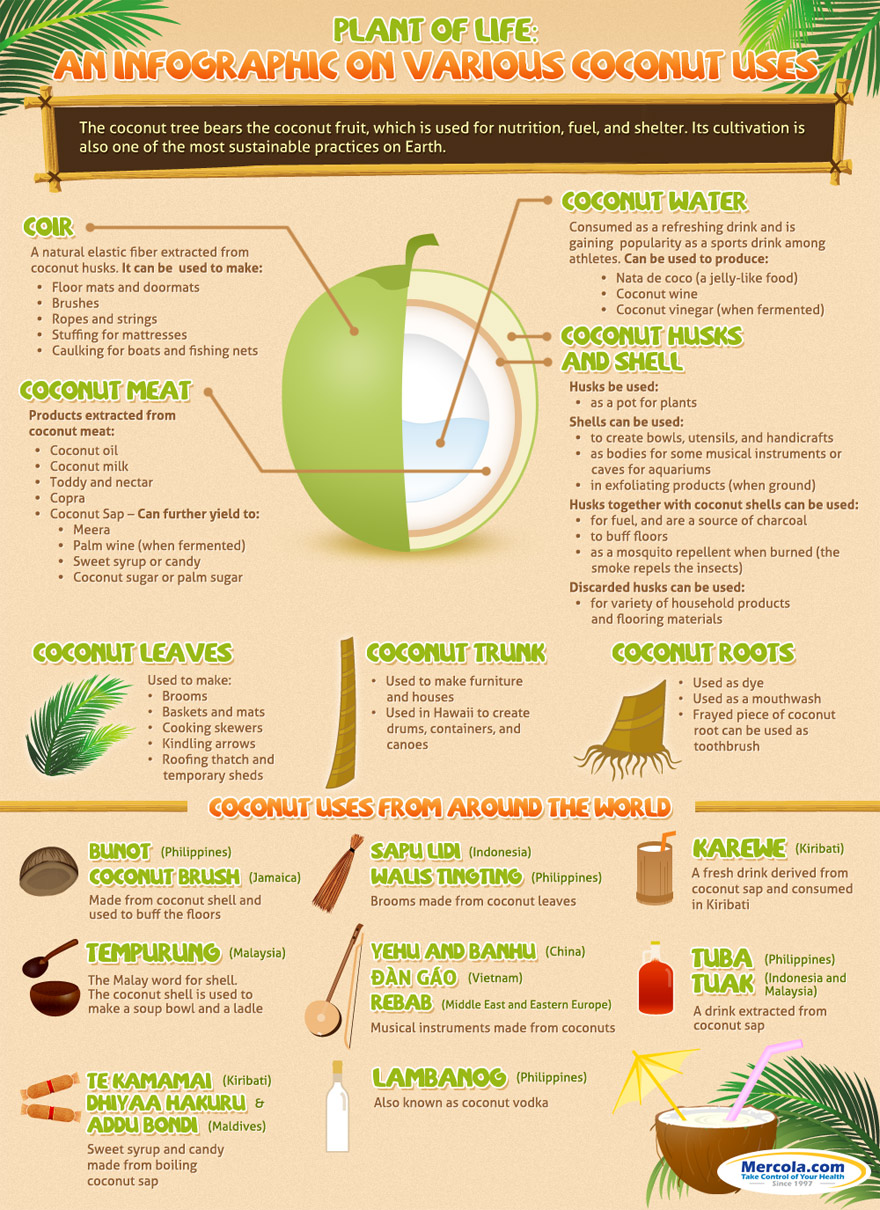
coconut uses infographic


Cococut Oil, the Friend to Athletes and Dieters

If you live in the United States, you have an almost 70 percent chance of being overweight.

And, by now, I'm sure you're well aware that obesity affects your quality of life and is linked to many health concerns.

One of the best benefits of coconut oil lies in its ability to help stimulate your metabolism.

Back in the 1940s, farmers found out about this effect by accident when they tried using inexpensive coconut oil to fatten their livestock.

It didn't work!

Instead, coconut oil made the animals lean, active and hungry.

However, many animal and human research studies have demonstrated that replacing LCFAs with MCFAs results in both decreased body weight and reduced fat deposition.

In fact, the ability of MCFAs to be easily digested, to help stimulate the metabolism and be turned into energy has entered the sports arena. Several studies have now shown that MCFAs can enhance physical or athletic performance.

Additionally, research has demonstrated that, due to its metabolic effect, coconut oil increases the activity of the thyroid. And you've probably heard that a sluggish thyroid is one reason why some people are unable to lose weight, no matter what they do.

Besides weight loss, there are other advantages to boosting your metabolic rate. Your healing process accelerates. Cell regeneration increases to replace old cells, and your immune system functions better overall.

Coconut Oil on Your Skin

Besides the mounting medical and scientific evidence that coconut oil has powerful positive health benefits when eaten, it has also been used for decades by professional massage therapists to knead away tight stressed muscles.

However, you don't have to be a professional massage therapist to gain the skin and tissue support benefits of coconut oil. Just use coconut oil as you would any lotion.

Coconut oil is actually ideal for skin care. It helps protect your skin from the aging effects of free radicals, and can help improve the appearance of skin with its anti-aging benefits.

In fact, physiologist and biochemist Ray Peat, Ph.D. considers coconut oil an antioxidant, due to its stability and resistance to oxidation and free radical formation. Plus, he believes it reduces our need for the antioxidant protection of vitamin E.

Like Dr. Peat, many experts believe coconut oil may help restore more youthful-looking skin. When coconut oil is absorbed into your skin and connective tissues, it helps to reduce the appearance of fine lines and wrinkles by helping to keep your connective tissues strong and supple, and aids in exfoliating the outer layer of dead skin cells, making your skin smoother.

Coconut Oil and Your Heart

Heart disease is the number one cause of death in the U.S. And heart disease is often a silent killer. The first sign of cardiovascular disease is commonly a heart attack, and sadly, over one third of heart attacks are fatal.

And despite the propaganda, the truth is this: it is UNSATURATED fats that are primarily involved in heart disease, not the naturally occurring saturated fats, as you have been led to believe.14

Plus, the polyunsaturated fats in vegetable and seed oils encourage the formation of blood clots by increasing platelet stickiness. Coconut oil helps to promote normal platelet function.

Coconut Oil in Your Kitchen

I only use two oils in my food preparation.

The first, extra-virgin olive oil, is a better monounsaturated fat that works great as a salad dressing.

However, it should not be used for cooking. Due to its chemical structure, heat makes it susceptible to oxidative damage.

And polyunsaturated fats, which include common vegetable oils such as corn, soy, safflower, sunflower and canola, are absolutely the worst oils to use in cooking. These omega-6 oils are highly susceptible to heat damage because of their double bonds.

I strongly urge you to throw out those omega-6 vegetable oils in your cabinets.

Why?

Reason # 1: Most people believe that frying creates trans-fat. That is not the major problem, in my opinion. Although some are created, they are relatively minor. There are FAR more toxic chemicals produced by frying omega-6 oils than trans-fat.

Frying destroys the antioxidants in oil and as a result oxidizes the oil. This causes cross-linking, cyclization, double-bond shifts, fragmentation and polymerization of oils that cause far more damage than trans-fat.

Reason # 2: Most of the vegetable oils are GMO. This would include over 90 percent of the soy, corn and canola oils.

Reason # 3: Vegetable oils contribute to the overabundance of damaged omega-6 fats in your diet, which creates an imbalance in the ratio of omega-6 to omega-3. As you know from my extensive writing on this subject, I believe that excessive consumption of damaged omega-6 fats contributes to many health concerns.

They are all highly processed and consumed in amounts that are about 100 times more than our ancestors did a century ago. This causes them to distort the sensitive omega-6/omega-3 ratio which controls many delicate biochemical pathways which results in accelerating many chronic degenerative diseases.

There is only one oil that is stable enough to resist mild heat-induced damage, while it also helps you promote heart health and even supports weight loss and thyroid function — coconut oil.

So, whenever you need an oil to cook with, use coconut oil instead of butter, olive oil, vegetable oil, margarine, or any other type of oil called for in recipes. Even though I don't fully recommend frying foods, if you must fry, by all means use coconut oil — it's your smartest choice.


Coconut Oil Safety

The medium-chain fats in coconut oil are considered so nutritious that they are used in baby formulas, in hospitals to feed the critically ill, those on tube feeding, and those with digestive problems. Coconut oil has even been used successfully by doctors in treating aluminum poisoning.15

Coconut oil is exceptionally helpful for pregnant women, nursing moms, the elderly, those concerned about digestive health, athletes (even weekend warriors), and those of you who just want to enhance your overall health."

To learn more about the author of this article, Dr. Joseph M. Mercola, visit his excellent website and online store at  www.Mercola.com.


Meantime, enjoy the below genius ways to incorporate Coconut Oil in your life provided by Thank Your Skin and give them a follow for lots more helpful tips and tricks!


10 Genius Ways To Use Coconut Oil For Healthy Skin

What is your favorite oil to use in food preparations?  

Do you have other favorite oils?  For example, I love Pomegranate Oil as an after bath moisturizer & Baobab Oil mixed into my nighttime facial moisturizer.


If you liked this post, say thanks by sharing.