Posts

Recipes Included

Raw Apple Cider Vinegar has been used for thousands of years as a natural health and beauty remedy.  At $4 a bottle, who knew it was such a miracle worker?  From burning fat, to banishing flu bugs (it's anti-viral, anti-septic & anti-bacterial), check out the many secrets of Raw Apple Cider Vinegar

(If you use preceding link, enter Code  ZLB966 at check out for $5 to $10 off your order!)


What are your home-remedy health & beauty secrets?


All Love,

Juliane


If you liked this post say thanks by sharing.


For the last week, Jim and I have been hiking, picnicking, wine-touring and dining our way through one of the the most beautiful places on earth… Napa Valley in CA.  This magical oasis of sundrenched olive groves, vineyards, giant red echinacea and gnarley cypress reminded us time and time again of our visits to both the Italian countryside and our recent trip to central Chile, which boasts a similarly mediterranean climate and terrain.


 Jim and me kicking off our wine tour at the Joseph Phelps Vineyard


While the majority of our time was spent in said countryside (details in future post) we also had the opportunity to spend one fine evening “Dishcrawling” through Downtown Napa, enjoying the flavors of four different restaurants all in one night.  See the history of Dishcrawl in my interview with Founder, Tracy Lee.


After each restaurant we took a quick commemorative photo to the tune of “Say Dishcrawl!”  Tarla, known for Turkish & Mediterranean Tapas, treated me to a lovely spinach, citrus & golden & ruby beet salad, and for everyone:  fresh pita w hummus & tzatziki and savory meatballs.


As with all Dishcrawl events, the names of the restaurants remain a surprise until the night of the crawl, unfolding to participants one by one as the evening progresses.  It’s a ton of fun in more ways than just great food, especially, Jim and I thought, if you’re not actually from the area!  We’d highly recommend the Dishcrawl experience to anyone traveling to a new city since it’s an excellent way to experience the city on foot (participants walk to each restaurant), meet locals and hear their inside stories of the region, and try out four wonderful restaurants all at once!  

It’s a unique and adventurous experience we never could have put together ourselves and a fantastic way to learn a brand new city quickly.  We met fabulous new friends and received tons of recommendations for additional places to go, see and do while visiting Napa and San Francisco.  

Bottome line, if you live in a Dishcrawl city (there are over 125 around the USA & Canada), participate to get to know great people and restaurants you might never have encountered.  And, if you happen to be traveling to a Dischcrawl city, get a quick snapshot of the region and a have a fabulous, fun night meeting new friends and trying four restaurants!  


Walking to our next stop… hmmm, wonder where we’re headed next!?


Our lovely Napa Dishcrawl ambassador, Cynthia Delgado, planned a fantastic evening for us which spanned the cuisines of Mexican, Turkish/Mediterranean Tapas, California Fusion and a dessert finale.  My absolute favorite was our first stop, the family-owned and operated Mexican restaurant, Cielito Lindo.  

Originally from Puerto Vallarta, this talented family knows how to creatively prepare the rich, undiscovered world of regional dishes that vary throughout Mexico. We were treated to delectable Mexican Shrimp Chipotle Sopes with freshly made guacamole.  And, they even made me my own vegetarian dish, Veggie Chiles Rellenos over white rice and black beans, all in the shape of a hot pepper… heavenly!  Let’s just say I’m ready to fly back to Napa to try out more of this beautiful family’s delicious and creative menu of authentic family favorites!   

Next time you’re in Napa, or if you’re already a local, be sure to stop in Cielito Lindo for absolutely fantastic, authentic Mexican food and the friendliest most attentive service imaginable.  Thank you Cielito Lindo!


The talented owner, Enrique Gonzalez, of Cielito Lindo and yours truly!


Authentic Mexican Sopes with a Modern Twist… is your mouth watering yet?!


And Cieleto Lindo’s Vegetarian dishes do NOT dissapoint!


The fine family behind Cielito Lindo took great care to explain the story behind the dishes we were served.  Everyone was oohing and ahing over their wonderful food as we ate!


Grace’s Table, serving California-Fusion style cuisine, had bistro-style, wide-open-walled, sidewalk seating. We were treated to fresh figs w or w/out prosciutto, corn bread w lavender honey butter & house made sausages.  Another fine establishment I’d highly recommend for a wonderful night out in Downtown Napa.  This is the talented owner next to yours truly:)


We made many wonderful friends!


And more terrific, new friends:-)  Such a fun night!

What city/s have you “Dishcrawled”? 

If you haven’t Dishcrawled yet, what city would interest you?

Much love,

Juliane

“Once you can accept the universe as matter expanding into nothing that is something, wearing stripes with plaid comes easy.” 
―Albert Einstein

If you liked this post say thanks by sharing.


Interview with Tracy Lee, Founder of the startup company, Dishcrawl. 


Check out my fun Interview with Tracy Lee, Founder of the uber cool startup, Dishcrawl!  Tracy shares how she started the epic new dining concept which is spreading like wildfire around the world… plus her super inspiring leadership tips!

Have you ever been to a Dishcrawl? If so, where?!

Please enjoy!

XOXO

Juliane


If you liked this post say thanks by sharing.

In light of my recent post, Epic Thai Coconut Smoothie, (which you must try as it's over-the-top delish), I wanted to share the amazing benenfits of Coconut Oil as well as dispel some myths about oils in general.  Please enjoy this outstanding, enlightening article by the renowned doctor and best-selling author, Dr. Joseph M. Mercola:


"This Cooking Oil is a Powerful Virus-Destroyer and Antibiotic…

You've no doubt noticed that for about the last 60 years the majority of health care officials and the media have been telling you saturated fats are bad for your health and lead to a host of negative consequences, like elevated cholesterol, obesity, heart disease and Alzheimer's disease.

Meanwhile during this same 60 years the American levels of heart disease, obesity, elevated serum cholesterol and Alzheimer's have skyrocketed compared to our ancestors, and even compared to modern-day primitive societies using saturated fat as a dietary staple.

Did you know that multiple studies on Pacific Island populations who get 30-60% of their total caloric intact from fully saturated coconut oil have all shown nearly non-existent rates of cardiovascular disease?1

Clearly, a lot of confusion and contradictory evidence exists on the subject of saturated fats, even among health care professionals.

But I'm going to tell you something that public health officials and the media aren't telling you.

The fact is, all saturated fats are not created equal.

The operative word here is "created", because some saturated fats occur naturally, while other fats are artificially manipulated into a saturated state through the man-made process called hydrogenation.

Hydrogenation manipulates vegetable and seed oils by adding hydrogen atoms while heating the oil, producing a rancid, thickened oil that really only benefits processed food shelf life and corporate profits.

The medical and scientific communities are now fairly united in the opinion thathydrogenated vegetable and seed oils should be avoided.

These unsaturated fats, artificially manipulated into saturated fats, are also called trans fats, and no doubt you've heard about them lately. Some cities and states have now outlawed their use. There is no controversy anymore regarding the health dangers of these artificially saturated fats.

And guess what?

These are the same damaged trans fats that have been touted as "healthy" and "heart-friendly" for the last 60 years by the vegetable and seed oil interests!

But the truth finally came out. Trans fat was rebuked, debunked, and revealed as the true enemy to good health that it has always been, regardless of what the seed- and vegetable oil shills told the American public for the last half century.

Unfortunately, this rightful vilification of hydrogenated saturated fats has created a lot of confusion regarding naturally occurring saturated fats, including coconut oil.

If one form of saturated fat is bad for you, the argument goes, then all saturated fat must be bad.

Right?

Nothing could be further from the truth!

The Truth about Coconut Oil

The truth about coconut oil is obvious to anyone who has studied the health of those who live in traditional tropical cultures, where coconut has been a nutritious diet staple for thousands of years.

Back in the 1930's, a dentist named Dr. Weston Price traveled throughout the South Pacific, examining traditional diets and their effect on dental and overall health. He found that those eating diets high in coconut products were healthy and trim, despite the high fat concentration in their diet, and that heart disease was virtually non-existent.

Similarly, in 1981, researchers studied populations of two Polynesian atolls. Coconut was the chief source of caloric energy in both groups. The results, published in the American Journal of Clinical Nutrition,2 demonstrated that both populations exhibited positive vascular health.

In fact, no evidence exists that the naturally occurring high saturated fat intake had any kind of harmful effect in these populations!

That's not what you expected, is it? Based on 60 years of negative public policy towards naturally occurring saturated fats, you would expect these cultures to be rife with clogged arteries, obesity and heart disease.

It may be surprising for you to realize that the naturally occurring saturated fat in coconut oil actually has some amazing health benefits, such as:

  • Promoting your heart health
  • Promoting weight loss, when needed
  • Supporting your immune system health
  • Supporting a healthy metabolism
  • Providing you with an immediate energy source
  • Keeping your skin healthy and youthful looking
  • Supporting the proper functioning of your thyroid gland

But how is this possible?

Does coconut oil have some secret ingredients not found in other saturated fats?

The answer is a resounding "yes".

Coconut Oil's Secret Ingredient

50 percent of the fat content in coconut oil is a fat rarely found in nature called lauric acid. If you're a frequent reader of my newsletter you already know that I consider lauric acid a "miracle" ingredient because of its unique health promoting properties.

Your body converts lauric acid into monolaurin, which has anti-viral, anti-bacterial and anti-protozoa properties.

Monolaurin is a monoglyceride which can actually destroy lipid coated viruses such as:

  • HIV, herpes
  • Measles
  • Influenza virus
  • Various pathogenic bacteria
  • Protozoa such as giardia lamblia.

Lauric acid is a powerful virus and gram-negative bacteria destroyer, and coconut oil contains the most lauric acid of any substance on earth!

Capric acid, another coconut fatty acid present in smaller amounts, has also been added to the list of coconut's antimicrobial components.

This is one of the key reasons you should consider consuming coconut oil, because there aren't many sources of monolaurin in our diet. But the health benefits of coconut oil don't stop there.

The Benefits of Medium-Chain Fatty Acids

Coconut oil is about 2/3 medium-chain fatty acids (MCFAs), also called medium-chain triglycerides or MCTs. These types of fatty acids produce a whole host of health benefits.

Coconut oil is nature's richest source of these healthy MCFAs.

By contrast, most common vegetable or seed oils are comprised of long chain fatty acids (LCFAs), also known as long-chain triglycerides or LCTs.

Let me tell you why these long-chain fatty acids are not as healthy for you as the MCFAs found in coconut oil.

  • LCFAs are difficult for your body to break down — they require special enzymes for digestion.
  • LCFAs put more strain on your pancreas, liver and your entire digestive system.
  • LCFAs are predominantly stored in your body as fat.
  • LCFAs can be deposited within your arteries in lipid forms such as cholesterol.
  • In contrast to LFCAs, the MCFAs found in coconut oil have many health benefits, including the following beneficial qualities:
  • MCFAs are smaller. They permeate cell membranes easily, and do not require special enzymes to be utilized effectively by your body.
  • MCFAs are easily digested, thus putting less strain on your digestive system.
  • MCFAs are sent directly to your liver, where they are immediately converted into energy rather than being stored as fat.
  • MCFAs actually help stimulate your body's metabolism, leading to weight loss.

Coconut Oil Helps Fight Diabetes

Your body sends medium-chain fatty acids directly to your liver to use as energy. This makes coconut oil a powerful source of instant energy to your body, a function usually served in the diet by simple carbohydrates.

But although coconut oil and simple carbohydrates share the ability to deliver quick energy to your body, they differ in one crucial respect.

Coconut oil does not produce an insulin spike in your bloodstream. You read that correctly, Coconut oil acts on your body like a carbohydrate, without any of the debilitating insulin-related effects associated with long-term high carbohydrate consumption!

Diabetics and those with pre-diabetes conditions (an exploding health epidemic in America), should immediately realize the benefit of a fast acting energy source that doesn't produce an insulin spike in your body. In fact, coconut oil added to the diets of diabetics and pre-diabetics has actually been shown to help stabilize weight gain, which can dramatically decrease your likelihood of getting adult onset type-2 Diabetes.


Did You Know?
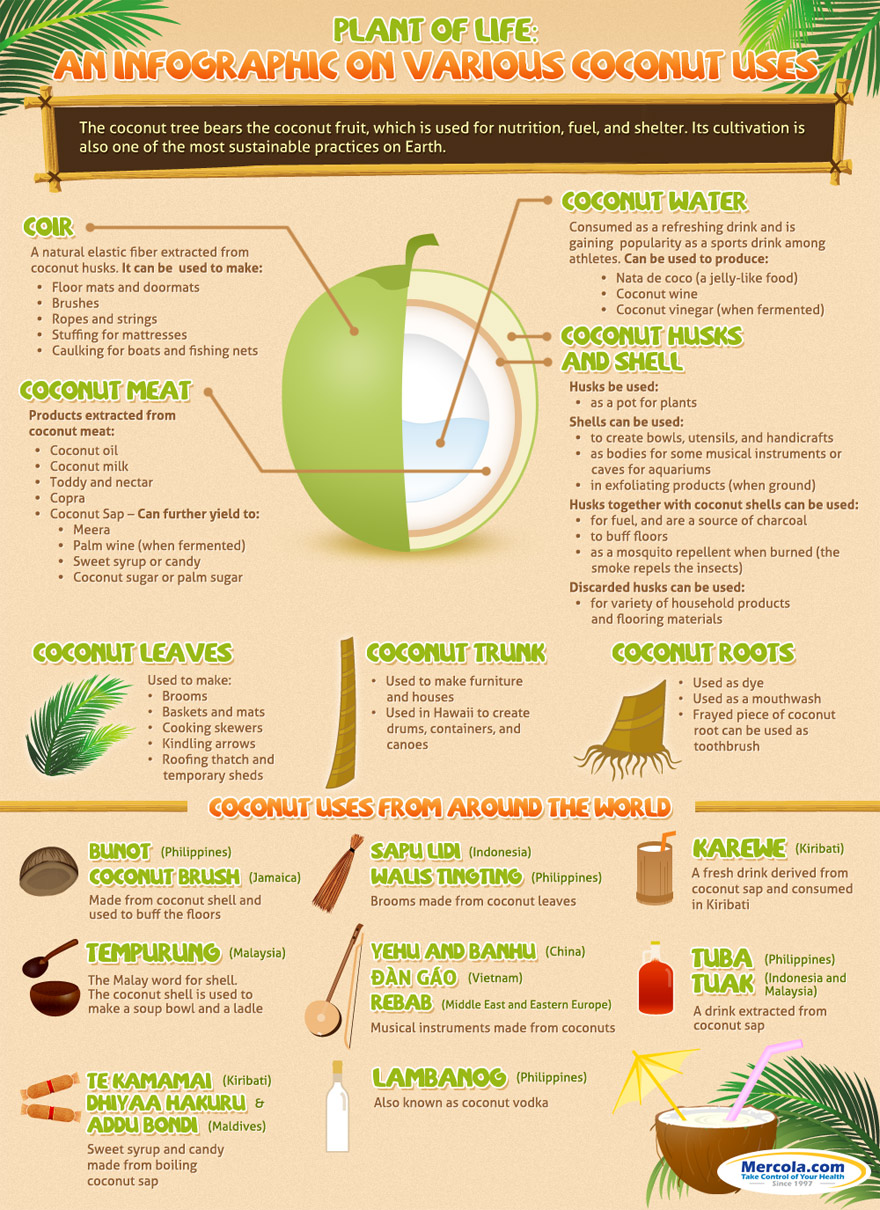
coconut uses infographic


Cococut Oil, the Friend to Athletes and Dieters

If you live in the United States, you have an almost 70 percent chance of being overweight.

And, by now, I'm sure you're well aware that obesity affects your quality of life and is linked to many health concerns.

One of the best benefits of coconut oil lies in its ability to help stimulate your metabolism.

Back in the 1940s, farmers found out about this effect by accident when they tried using inexpensive coconut oil to fatten their livestock.

It didn't work!

Instead, coconut oil made the animals lean, active and hungry.

However, many animal and human research studies have demonstrated that replacing LCFAs with MCFAs results in both decreased body weight and reduced fat deposition.

In fact, the ability of MCFAs to be easily digested, to help stimulate the metabolism and be turned into energy has entered the sports arena. Several studies have now shown that MCFAs can enhance physical or athletic performance.

Additionally, research has demonstrated that, due to its metabolic effect, coconut oil increases the activity of the thyroid. And you've probably heard that a sluggish thyroid is one reason why some people are unable to lose weight, no matter what they do.

Besides weight loss, there are other advantages to boosting your metabolic rate. Your healing process accelerates. Cell regeneration increases to replace old cells, and your immune system functions better overall.

Coconut Oil on Your Skin

Besides the mounting medical and scientific evidence that coconut oil has powerful positive health benefits when eaten, it has also been used for decades by professional massage therapists to knead away tight stressed muscles.

However, you don't have to be a professional massage therapist to gain the skin and tissue support benefits of coconut oil. Just use coconut oil as you would any lotion.

Coconut oil is actually ideal for skin care. It helps protect your skin from the aging effects of free radicals, and can help improve the appearance of skin with its anti-aging benefits.

In fact, physiologist and biochemist Ray Peat, Ph.D. considers coconut oil an antioxidant, due to its stability and resistance to oxidation and free radical formation. Plus, he believes it reduces our need for the antioxidant protection of vitamin E.

Like Dr. Peat, many experts believe coconut oil may help restore more youthful-looking skin. When coconut oil is absorbed into your skin and connective tissues, it helps to reduce the appearance of fine lines and wrinkles by helping to keep your connective tissues strong and supple, and aids in exfoliating the outer layer of dead skin cells, making your skin smoother.

Coconut Oil and Your Heart

Heart disease is the number one cause of death in the U.S. And heart disease is often a silent killer. The first sign of cardiovascular disease is commonly a heart attack, and sadly, over one third of heart attacks are fatal.

And despite the propaganda, the truth is this: it is UNSATURATED fats that are primarily involved in heart disease, not the naturally occurring saturated fats, as you have been led to believe.14

Plus, the polyunsaturated fats in vegetable and seed oils encourage the formation of blood clots by increasing platelet stickiness. Coconut oil helps to promote normal platelet function.

Coconut Oil in Your Kitchen

I only use two oils in my food preparation.

The first, extra-virgin olive oil, is a better monounsaturated fat that works great as a salad dressing.

However, it should not be used for cooking. Due to its chemical structure, heat makes it susceptible to oxidative damage.

And polyunsaturated fats, which include common vegetable oils such as corn, soy, safflower, sunflower and canola, are absolutely the worst oils to use in cooking. These omega-6 oils are highly susceptible to heat damage because of their double bonds.

I strongly urge you to throw out those omega-6 vegetable oils in your cabinets.

Why?

Reason # 1: Most people believe that frying creates trans-fat. That is not the major problem, in my opinion. Although some are created, they are relatively minor. There are FAR more toxic chemicals produced by frying omega-6 oils than trans-fat.

Frying destroys the antioxidants in oil and as a result oxidizes the oil. This causes cross-linking, cyclization, double-bond shifts, fragmentation and polymerization of oils that cause far more damage than trans-fat.

Reason # 2: Most of the vegetable oils are GMO. This would include over 90 percent of the soy, corn and canola oils.

Reason # 3: Vegetable oils contribute to the overabundance of damaged omega-6 fats in your diet, which creates an imbalance in the ratio of omega-6 to omega-3. As you know from my extensive writing on this subject, I believe that excessive consumption of damaged omega-6 fats contributes to many health concerns.

They are all highly processed and consumed in amounts that are about 100 times more than our ancestors did a century ago. This causes them to distort the sensitive omega-6/omega-3 ratio which controls many delicate biochemical pathways which results in accelerating many chronic degenerative diseases.

There is only one oil that is stable enough to resist mild heat-induced damage, while it also helps you promote heart health and even supports weight loss and thyroid function — coconut oil.

So, whenever you need an oil to cook with, use coconut oil instead of butter, olive oil, vegetable oil, margarine, or any other type of oil called for in recipes. Even though I don't fully recommend frying foods, if you must fry, by all means use coconut oil — it's your smartest choice.


Coconut Oil Safety

The medium-chain fats in coconut oil are considered so nutritious that they are used in baby formulas, in hospitals to feed the critically ill, those on tube feeding, and those with digestive problems. Coconut oil has even been used successfully by doctors in treating aluminum poisoning.15

Coconut oil is exceptionally helpful for pregnant women, nursing moms, the elderly, those concerned about digestive health, athletes (even weekend warriors), and those of you who just want to enhance your overall health."

To learn more about the author of this article, Dr. Joseph M. Mercola, visit his excellent website and online store at  www.Mercola.com.


Meantime, enjoy the below genius ways to incorporate Coconut Oil in your life provided by Thank Your Skin and give them a follow for lots more helpful tips and tricks!


10 Genius Ways To Use Coconut Oil For Healthy Skin

What is your favorite oil to use in food preparations?  

Do you have other favorite oils?  For example, I love Pomegranate Oil as an after bath moisturizer & Baobab Oil mixed into my nighttime facial moisturizer.


If you liked this post, say thanks by sharing. 

IMG_2526
Tom Yum Soup


Who's ready for an insanely delicous, 15 minute Thai recipe?

Enter:  Tom Yum Soup

This stealthy combination of silky-smooth coconut milk, lemongrass, shitakes, and ginger is rich and magical.  Papery-thin slivers of chicken drenched in vibrant, buttery broth deliver perfection in every spoonful.

A dish this simple- yet so complex, so incredibly delicious, is a keeper in my repertoire! Soul warming, refreshing and filling at the same time.  I’m obsessed

~ you will be too!


IMG_2478
Ingredients for Tom Yum Soup


Recipe for Tom Yum Soup (Serves 4)

Ingredients (substitute tofu & vegetable stock for vegetarian version)

  • 5 cups reduced sodium chicken stock
  • 1 stalk lemongrass thinly sliced into rounds
  • 1 inch piece fresh ginger root thinly sliced
  • 1 large clove garlic, minced
  • 1 tsp thinly sliced, fresh, medium-heat red chili pepper + slices for garnish (seed & devein for less heat)
  • 2 cooked pasture raised, chicken breasts, thinly sliced across the grain **(See Note below)
  • 1 ½ cups thinly sliced shitake mushrooms
  • 3/4 cup coconut milk (DON’T use light!)
  • 2 tablespoons fish sauce
  • 2 tablespoons fresh lime juice
  • 2 tablespoons fresh cilantro + extra for garnish

 Method

  1. In a large pot combine first 5 ingredients (chicken stock through red chilies) and bring to a simmer for about 5 minutes.
  2. Add remaining ingredients and simmer 1 minute.
  3. Ladle into bowls adding extra fresh cilantro leaves & thinly sliced chili pepper for garnish.  Enjoy!
**For perfect, easy roast chicken breasts:  Preheat oven to 400F.  Spray heavy duty, rimmed baking sheet with grapeseed oil (or canola) spray.  Rub chicken breasts with a small amount of grapeseed (or canola) oil to coat and sprinkle with salt and pepper.  Roast for 30-35 minutes or until cooked through. Let rest for 10 minutes in order to let the juices redistribute into the meat- otherwise those beautiful juices will all run out onto your cutting board & you'll be left with dry meat & no flavor!

IMG_2496
Tom Yum Soup Simmering Away!

Questions of the day:

Do you have a favorite Thai dish?

What is your favorite cuisine?

Living Beautifully via Holistic LifeStyle, Food & Art

Holistic LifeStyle:  The effervescence underneath it all… Holistic treasures to keep you, your home & your life happy, healthy & beautiful!

Food:  Delicious, organic recipes and memorable food inspirations.  UPDATE** As of mid 2012 my recipes are primarily Vegan & Raw using fresh, beautiful fruits, vegetables & whole plant-based ingredients.  However, everyone is welcome!  While I now personally avoid dairy, gluten, refined sugar & animal products, you'll find fantastic recipes across the spectrum – ranging from my pre-vegetarian days of whole foods dishes to gluten & dairy free fare, vegetarian recipes & now many Raw & Vegan recipes.  **All dishes are customizable to suit your personal FoodStyle  join the growing group of friends who've contacted me to 'upgrade' their favorites to out-of-this world vegan or raw vegan!  I'm up for the challenge!

And Art:  My paintings, including such details as where to buy the lovely necklace and cardigan featured in one of my recent portraits.  Also feel free to visit my Fine Art website www.JulianePorter.com to view more of my commissioned Portraits, Landscapes & Private Collection pieces.

PS. Don't forget to leave a comment to say hello while you're here! I love to hear from you 🙂

  Work.5841769.8.flat,800x800,070,f

Watercolor on Winsor Newton Paper (Click image for better, larger view)

This Pecan Pie is the bomb!

Something about pie, part challenge to produce a flaky, delicate crust, part novelty for all the different kinds- from sweet to savory.  May I be so daring as to call myself an experienced pie-maker?  I’ve made at least 50 pies by now!  And, it’s your lucky day, because after having tested a multitude of pie dough recipes, I’ve posted (below) what I’ve found to be by-far the flakiest, tastiest and most successful pie crust of all!

Within the sweet realm, my favorites include French Pumpkin Hazelnut, Dried Pear Caramel Dark Chocolate and Classic Apple.  Today I’ve tried my hand at Pecan Pie for the first time and let me say it did not disappoint!  Don’t forget a little ball of ice-cream  on the side. Heaven!

PS.  I’ll be testing out savory Individual Lobster Pot Pies on my husband before serving them for a party we’re hosting.  Wish me luck… and stay tuned for the post.

Pecan Pie (serves 8)

3 oz. (6 Tbs.) unsalted butter

3/4 cup packed dark brown sugar

3/4 cup light or dark corn syrup

1/2 cup Lyle’s Golden Syrup (or use Grade B Maple Syrup like I did, you’ll get a slightly looser texture)

3 large eggs, at room temperature

2 Tbs. bourbon

1 Tbs. instant espresso powder

1 tsp. pure vanilla extract

3/4 tsp. table salt

1/3 cup very finely chopped toasted pecans

2 cups toasted pecan halves

1 blind-baked all-butter piecrust, (Below), or use a store bought crust to really make your life easy

1/2 cup crushed chocolate toffee candy pieces, such as Heath or Skor


Position a rack in the center of the oven, set a heavy-duty rimmed baking sheet on the rack, and heat the oven to 375°F.

In a medium saucepan over medium heat, melt the butter and cook, swirling the pan occasionally, until the butter is brown, 3 to 5 minutes. Immediately whisk in the brown sugar, corn syrup, and Lyle’s Golden Syrup (or Maple Syrup if using) until smooth. Remove the pan from the heat and let cool slightly.

One at a time, whisk in the eggs. Whisk in the bourbon, espresso powder, vanilla, and salt. Stir in the chopped pecans.

Sprinkle half of the pecan halves in the piecrust, followed by the toffee candy pieces, and then the remaining pecan halves. Pour the syrup mixture over all.

Put the pie on the heated baking sheet and reduce the oven temperature to 350°F. Bake until set, 45 to 55 minutes, rotating the pan halfway through baking. When the pan is nudged, the center of the pie will no longer wobble, but the whole pie will jiggle just slightly, and the filling will bubble at the edges.

Transfer to a rack and cool completely before serving. The pie can be stored at room temperature for up to 2 days.

Email me if you want this recipe veganized, raw veganized, gluten freed or dairy freed 🙂

Recipe adapted from/Inspired by Fine Cooking 101, pp. 63 November 18, 2010

My Favorite All Butter Pie Crust (Yields Two, 10” Pie Crusts) 

12 tablespoons (1 1/2 sticks) very cold unsalted butter

3 cups all-purpose flour

1 teaspoon kosher  salt

1 tablespoon sugar

1/3 cup very cold vegetable shortening

6-8 tablespoons (about ½ cup) ice water

Dice the butter and return it to the refrigerator while you prepare the flour mixture.

Place the flour, salt, and sugar in the bowl of a food processor fitted with a steel blade and pulse a few times to mix. Add the butter and shortening. Pulse 8-12 times, until the butter is the size of peas.

With the machine running, pour the ice water down the feed tube and pulse the machine until the dough begins to form a ball.

Dump out on a floured board, divide in half.  Gently form each half into a disc with smooth edges. It may feel strange not to, but don’t chill the dough yet. Shape it into two disks and start rolling; you can chill the dough once the pie is assembled. This method is unconventional, but author Carolyn Weil says that ultimately you get the most tender result because you don’t have to struggle with a disk of chilled, hard dough.  (If only making one pecan  pie you may double-wrap 2nd half tightly and  freeze the dough for up to 2 months.)

Roll each piece on a well-floured board into a circle, rolling from the center to the edge, turning and flouring the dough to make sure it doesn’t stick to the board. Fold the dough in half, place in a pie pan, and unfold to fit the pan.  Trim the dough to 1” from the edge of pan. (If you have scraps, save them to make one or two little “donuts” for a chef’s treat!  Bake then dip in powdered sugar or jam- yum!) Roll the dough under itself into a cylinder that rests on the edge of the pan.  Crimp the edge and refrigerate about 1 hour or overnight.  This will relax the dough and help prevent the edges from caving in.

Blind-Baking the Crust

Position a rack in the center of the oven and preheat to 425 F. Line the chilled piecrust with foil and fill it all the way to the top (important, otherwise the edges will slip) with pie weights or dried beans.  Bake for 15 minutes, then remove- carefully- the foil and beans/weights. Reduce the oven temperature to 375 F. Bake until the bottom looks dry but isn’t quite done and the edges are light golden, about 5-7 minutes. Cool on a rack.

Email me if you want this recipe veganized, raw veganized, gluten freed or dairy freed 🙂

Pie Dough Recipe Adapted from Ina Garten of Barefoot Contessa


If you enjoyed this post say thanks by sharing.